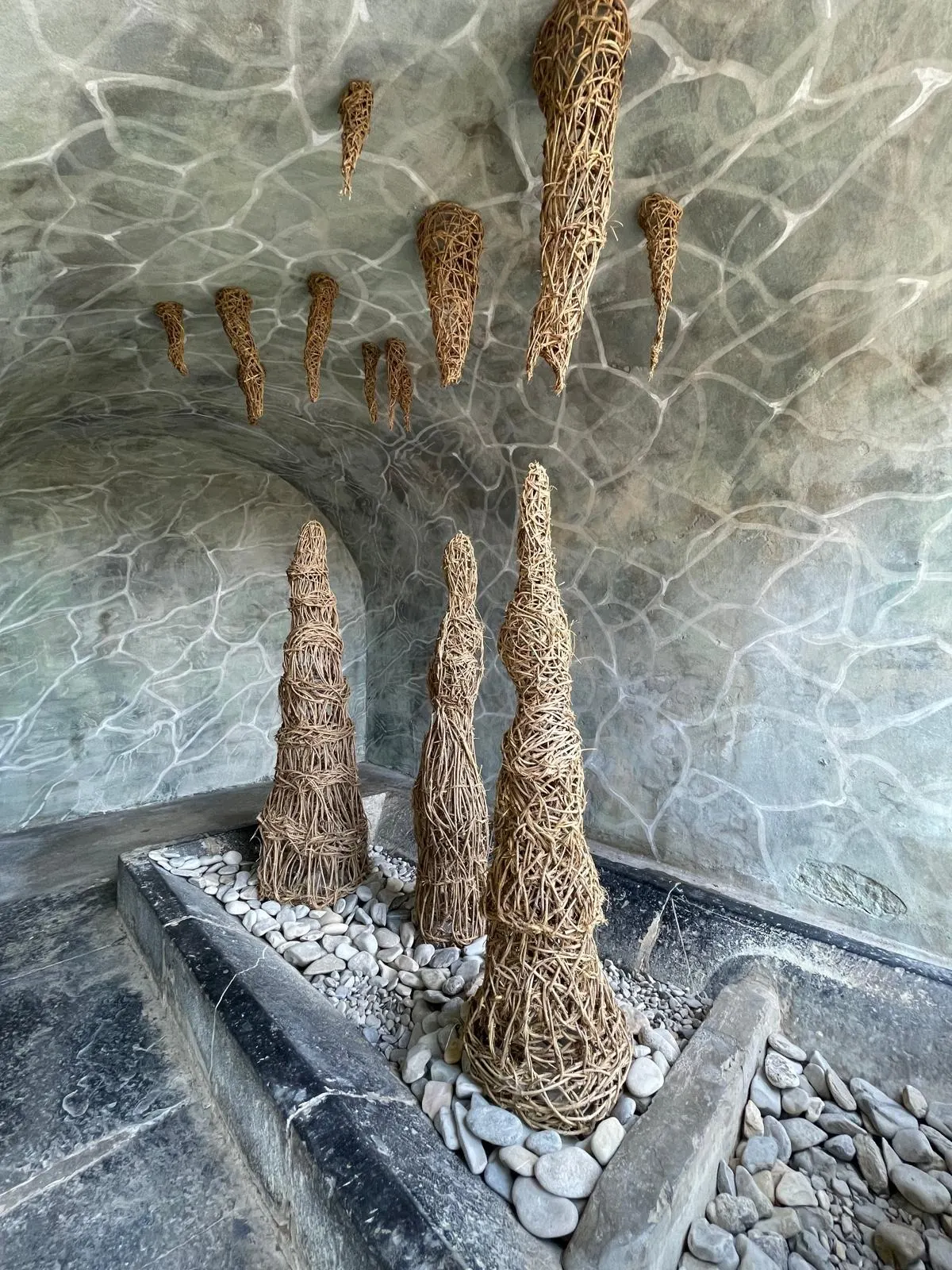
Installation
The Sainte Catherine washhouse, with its vaulted structure reminiscent of a cave, inspired this installation. These formations, crafted from wild clematis, represent the meeting point of water, mineral, and plant life. Today, the washhouse stands as a historical landmark; it is no longer in use. This work aims to bring the underground world—and the springs so prevalent in this region—back to the surface. It invites us to trace the paths of water and the vast span of time required to sculpt these limestone rocks. The cave serves as a metaphor for the depths and for confinement, yet also as the point of origin for all emerging forms— as if this descent into the depths were a necessary passage for the birth of new figures, metamorphoses, and narratives. Regarding the installation's materials: affinities with limestone and water The washhouse walls are painted with a pattern of water reflections, inviting the viewer to become immersed in the space. The paint used is a lime wash (a material derived from limestone). Wild clematis is a plant that thrives in water and on limestone soils.
